
Choosing the words for a bronze memorial plaque is harder than it looks. The space is small, the words will be read for decades, and they have to say something true about a whole life in a line or two. This guide gives you a simple structure to follow, wording examples for every relationship and setting, a list of short phrases that read well in raised bronze, and a way to check that your inscription will fit the plaque before anything is cast.
See your wording on a real plaque
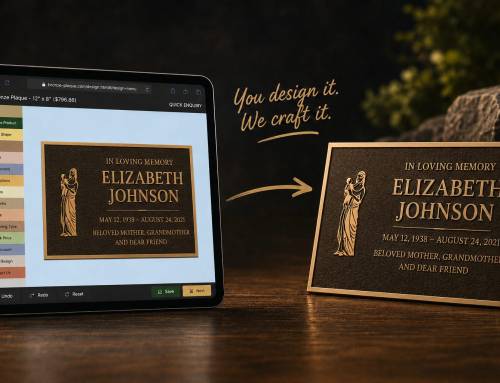
Type the inscription into our free online designer, choose a size and font, and the plaque appears on screen at true scale with its price. Nothing is cast until you approve a written proof.
Explore: bronze memorial plaques · bronze grave markers · bronze plaque sizes
The four parts of a memorial plaque inscription
Nearly every memorial plaque that reads well is built from the same four parts, in this order. You do not need all four, but keeping the order makes the plaque easy to read at a glance.
- An opening line. In Loving Memory of, In Memory of, Beloved Husband and Father, Here Lies, or simply Remembering. On a small plaque this line is often left out and the name stands alone.
- The name. The name the person was known by, set larger than everything else. Decide early whether to use a full legal name, a familiar name, or both, for example Margaret “Peggy” Anne Walker. Check the spelling with two family members.
- The dates. Birth and death years are enough for most plaques (1938 to 2026). Full dates are common on grave markers (March 3, 1938 to June 18, 2026). Choose one format and keep it for everyone named on the plaque.
- A closing line. A relationship, a short phrase, a line of verse or scripture, or a few words in the person’s own voice. This is the line people remember, so it deserves the most thought.
A photo, an emblem or a motif can take the place of the opening line or sit beside the name. If the plaque is for a cemetery, ask the office whether it has rules on wording, such as no nicknames or no quotations, before you design.
Wording examples by relationship
Each example is written to fit a 12 by 8 inch plaque in five or six lines. Shorten it for a smaller plaque by dropping the opening line or the closing verse.
Mother or father
- In Loving Memory of Rosa Maria Delgado, 1946 to 2025, Beloved Mother and Grandmother, Her love was the light of our home
- James Patrick O’Neill, 1951 to 2026, Devoted Father, Teacher and Friend, He taught us how to live
- Remembering Mom, Carol Jean Fischer, 1939 to 2026, Always in our hearts, always at our table
Husband or wife
- Together Forever, Robert and Helen Marsh, 1932 to 2019 and 1934 to 2026, Married 64 years
- In Loving Memory of my husband, Daniel Reyes, 1960 to 2025, Until we meet again
- Anne Louise Carter, 1955 to 2026, Beloved Wife, Best Friend, Loved beyond words, missed beyond measure
Son, daughter or child
- Our Beloved Son, Michael Thomas Grant, 1998 to 2024, Forever young, forever loved
- Emily Rose Chen, 2015 to 2023, Our little light, You brought us so much joy
- In Memory of Baby Noah, Born and died May 2, 2026, Held for a moment, loved for a lifetime
Grandparent
- In Loving Memory of Grandpa Joe, Joseph A. Kowalski, 1930 to 2026, Storyteller, gardener, friend to all
- Nana, Dorothy Mae Hughes, 1935 to 2025, Her kitchen was always open and her arms were always warm
Brother, sister or friend
- In Memory of William “Billy” Shaw, 1970 to 2026, Brother, Uncle, Loyal Friend, Gone fishing
- Sarah Lynn Brooks, 1982 to 2025, A friend to everyone she met, Her laughter lives on in us
A pet
- Max, 2011 to 2024, Our faithful friend, Good boy, always
- In Memory of Luna, 2009 to 2025, She chose us, Run free, sweet girl
- Bella, 2014 to 2026, A small dog with a big heart, Loved by the whole family
Our outdoor pet memorial plaques page has more pet inscriptions and the sizes they suit.
Wording examples by setting
Grave marker or headstone plaque
Cemetery plaques carry the fullest wording: full name, full dates, relationship and a verse or scripture line. Many cemeteries also allow an emblem such as a cross, a Star of David, a military branch or a flower. If the plaque is a companion marker for two people, place the names side by side with the dates beneath each and one shared line at the bottom. See bronze grave markers and bronze plaques for headstones for sizes and cemetery rules.
Garden plaque
A garden plaque can be warmer and less formal: Grandad’s Garden, Planted in memory of Ruth who loved every rose, or a line the person used to say. Short, lower key wording suits a plaque on a stone among plants. Our memorial garden plaques page has examples.
Bench plaque
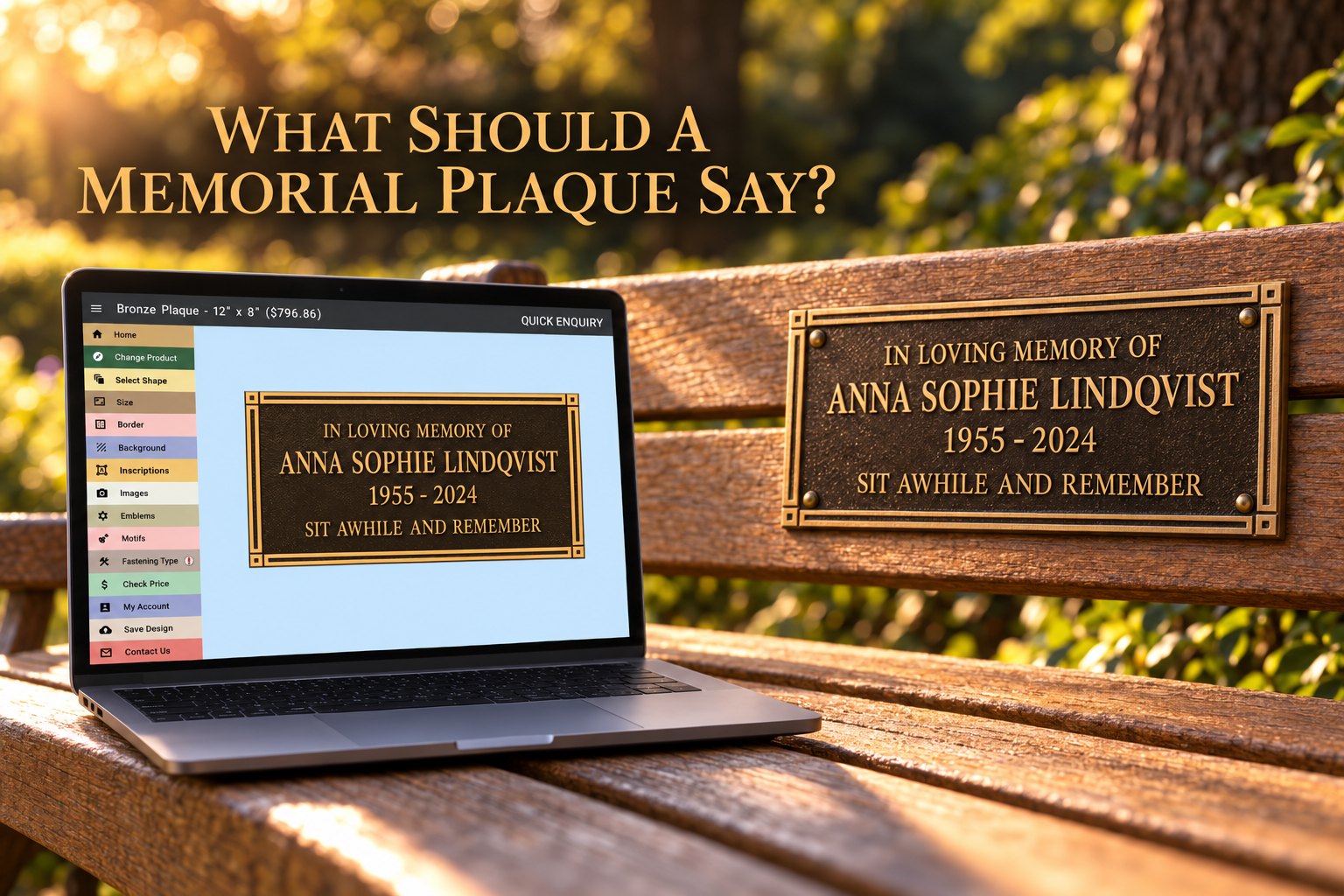
Bench plaques are read by strangers who sit down, so a line that invites them works well: Sit a while and remember Tom, In memory of Jane who loved this view, Rest here, as he did, every morning. Park programs often limit the plaque to two or three lines and may not allow dates or quotations. See memorial bench plaques for program sizes.
Tree plaque
Tree plaques are small, so three short lines are usual: This tree was planted in memory of Ana Lucia Ferreira, 1972 to 2025, Grow strong, as she did. Our memorial tree plaques page explains the stake and post options.
Columbarium niche
Niche fronts are compact and often shared, so cemeteries usually specify the layout: name, dates and sometimes a single short line or an emblem. Our columbarium niche plaques page covers the measurements and rules.
Dedication or commemorative plaque
Plaques for buildings, events and anniversaries follow a different order: what happened, when, who was involved and who placed the plaque. For example: This library was dedicated on October 4, 2026 in memory of Harriet Vance, librarian for 38 years, by the Friends of Oakdale Library. Our commemorative bronze plaques and building dedication plaques pages have the formal versions.
Short phrases that read well in bronze
A memorial phrase has to work in raised capitals at a quarter inch high, read from a few feet away. These have stood that test for generations. Mix them, shorten them or use them as the starting point for a line of your own.
Love and remembrance
- Forever in our hearts
- Always loved, never forgotten
- Loved beyond words, missed beyond measure
- Gone but never forgotten
- In our hearts forever
- Until we meet again
- Loved by all who knew him
- Her light still shines
Rest and peace
- Rest in peace
- At rest
- Peace at last
- Safe in the arms of God
- Asleep in Jesus
- Home at last
A life lived
- A life well lived
- He lived with honor
- She made the world kinder
- Devoted to family, faith and friends
- Well done, good and faithful servant
- A gentle soul, a generous heart
Scripture and verse
- The Lord is my shepherd (Psalm 23:1)
- I have fought the good fight, I have finished the race (2 Timothy 4:7)
- Love never fails (1 Corinthians 13:8)
- Blessed are the pure in heart (Matthew 5:8)
- May the road rise to meet you (traditional Irish blessing)
- To live in hearts we leave behind is not to die (Thomas Campbell)
In their own voice
Some of the best closing lines are things the person actually said: See you at the lake. Don’t forget to feed the birds. Be kind, it costs nothing. If the family smiles when they read it, it belongs on the plaque.
How many words will fit
At a quarter inch letter height, a bronze plaque holds about three to four characters per inch of width, including spaces. A 6 by 4 inch plaque comfortably takes 40 to 60 characters in three lines, an 8 by 6 takes 80 to 120 in four or five lines, and a 12 by 8 takes 150 to 200 in six lines. A quick check is to count every character and space in your inscription and divide by four: that is roughly the number of square inches you need. Names are usually set larger, which uses extra room, and a photo or motif takes the space of about two lines. If the wording will not fit, shorten the opening line first, then the verse; keep the name and dates whole. Our bronze plaque sizes guide lists the standard sizes and what each one holds, and the online designer shows your wording at true scale as you type.
Tone, capitals and punctuation
- Match the tone to the place. A cemetery plaque is usually formal; a garden, bench or pet plaque can be warm and plain spoken. Read the words aloud and imagine a stranger reading them in twenty years.
- Capitals or mixed case. Names and opening lines are traditionally in capitals; a verse or quotation often reads better in mixed case. Avoid all capitals for a long line, it becomes hard to read.
- Keep punctuation light. Bronze letters are cast one by one, so a comma or period is a tiny raised mark that can look like a flaw. Line breaks do the work of punctuation on a plaque.
- Write dates in full words or full numbers. June 18, 2026 or 06.18.2026, not both styles on one plaque, and avoid abbreviations that someone outside the family would not understand.
- Use “to” or a space between years. A plain dash between years is common, but a small raised dash can read as a scratch; many families choose 1938 to 2026 or set the years on separate lines.
Check everything before casting
Bronze cannot be edited after it is cast. Before you approve the proof, have two people who knew the person check the spelling of every name, every date against a document, and the exact wording of any quotation. Confirm the cemetery or program has approved the inscription if it has rules. Then look at the proof at the size it will be seen from and ask whether it says what you meant. If it does, it is ready.
Ready to see the words in bronze?
Open the designer, type your inscription, pick a size and font, and see the plaque with its price. Our design team will check the wording and send a free proof before anything is cast.
Explore: bronze plaque prices · custom bronze plaques · bronze plaques with photo